


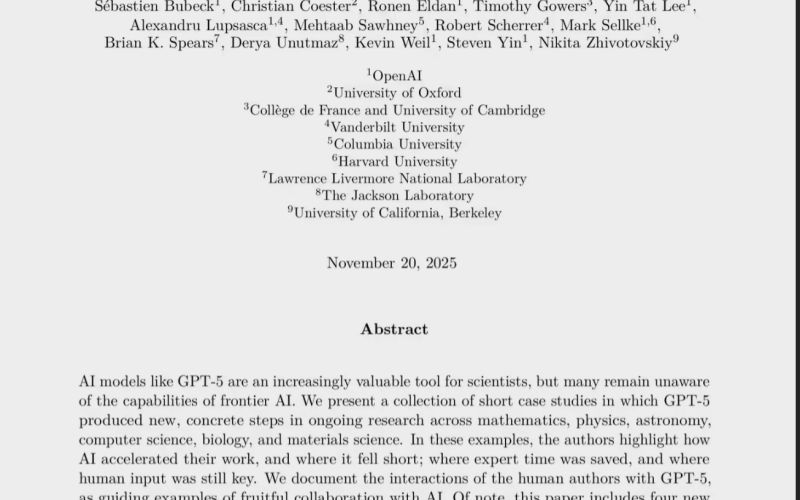
Yesterday, OpenAI officially released the paper "GPT-5 for Scientific Acceleration," demonstrating how scientists are already utilising AI in their daily work.
The paper states that mathematicians are using GPT-5 to prove theorems and formulas, physicists are employing it for symmetry analysis, and immunologists are leveraging GPT-5 to refine hypotheses and design experiments.
OpenAI researcher Noam Brown rejected the notion that “generative AI merely regurgitates internet content.” He argued that models like GPT-5 capture the full spectrum of human reasoning and writing processes, and reinforcement learning (RL) can push AI far beyond the level of “parroting.”
He compared GPT to Google’s AlphaGo: AlphaGo first learned from human games, then, through reinforcement learning, invented moves that were initially considered mistakes by experts but ultimately proved correct.
Noam believes that real science is far more complex than Go. Although AI has not yet surpassed the world’s top scientists, large language models are already making meaningful contributions to actual research. He suggested that science may one day experience its own “Move 37” moment, akin to what happened in Go.
modezone.com note: “Move 37” refers to the 37th move made by AlphaGo (playing black) against Korean 9-dan professional Lee Sedol in the first game of their March 2016 match. AlphaGo placed the stone on the 5th line near the top star point—a move that virtually all professional players at the time regarded as unreasonable and contrary to established Go theory. Yet as the game progressed, that move became the key to victory. It has been proven that AI possesses creative thinking capabilities; it does not merely imitate human play but explores paths that humans have never considered, demonstrating that AI can create new knowledge rather than copy old knowledge.
Back to the main topic—one of GPT-5’s clear strengths is helping researchers locate relevant papers buried under massive volumes of publications and shifting terminology. Experiments showed that GPT-5 can generate complete proofs in seconds, whereas Fields Medalist Sir Timothy Gowers needed more than an hour to complete the same reasoning task.
In biology, researchers often ask GPT-5 why a specific compound causes a particular phenotype, and GPT-5 can provide plausible causal chains and experimental suggestions to support their understanding.
At the same time, GPT-5 can act as a “technical critic,” analysing why an experiment might fail. It is not flawless in every scenario—sometimes it requires questioning before self-correcting—but this process still provides scientists with valuable insights.
That said, GPT-5 is far from perfect. It does not resolve issues of copyright attribution or originality, occasionally overstates incomplete results, and exhibits clear “subject bias,” performing significantly better in formal disciplines such as mathematics, theoretical physics, and algorithms than in others.
Overall, scientists are already using GPT-5 for real research tasks. It demonstrates genuine practical utility without yet producing paradigm-shifting breakthroughs, and humans remain firmly in control of setting research directions and performing final review.
The above content is compiled by ModeZone, a fashion and entertainment magazine.