


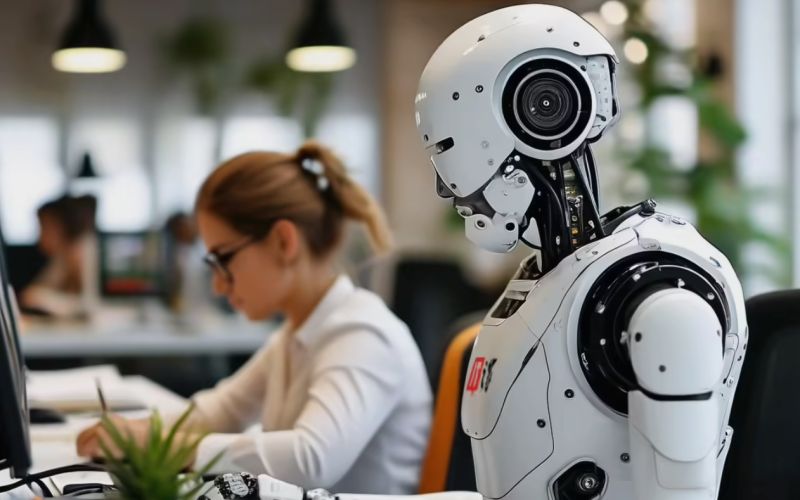
What Musk Says: AI & Robots as the Only Path out of Debt
According to recent reports, Musk argued that the mounting U.S. federal debt — now reportedly exceeding $38.34 trillion — is unsustainable under current conditions.
Musk said in a podcast / public forum that “the only way to get us out of the debt crisis and prevent America from going bankrupt is AI and robotics.”
He warned that if productivity doesn’t dramatically increase, the debt situation will become untenable: “If AI and robots don’t solve our national debt, we’re toast.”
💡 His Logic: How AI & Robotics Could Help
- Boost Output & Productivity — By deploying AI and robotics at scale, Musk believes the U.S. could sharply increase production of goods and services, thereby expanding real economic output.
- Stretch Fiscal Capacity — Higher productivity would generate higher economic growth, which in turn could raise tax revenues and ease the burden of interest payments on national debt.
- Automate High-Cost Industries — Musk points to his experience at companies like Tesla and SpaceX, noting that industries relying heavily on automation already deliver efficiency gains. He argues that widespread automation could replicate that effect on an economy-wide scale.
- Overcome Structural Constraints — He suggests that traditional political or fiscal policy tools may not be sufficient; only technological transformation (via AI/robotics) can generate sufficiently large and sustained growth to counteract debt pressures.
⚠️ What Remains Uncertain, & Why It’s Controversial
While provocative and ambitious, Musk’s proposal raises many questions:
- Implementation scale and timeline — Scaling AI and robotics usage across a national economy is a massive, multi‑decade undertaking; it’s unclear whether it can ramp up fast enough to counteract rapidly growing debt and interest obligations.
- Economic distribution & employment — Automation may boost productivity — but not everyone benefits equally. Workers displaced by robotics may face unemployment; without substantial economic redistribution or retraining efforts, inequality or social instability may increase.
- Structural & systemic issues — Debt is only one part of a complex fiscal system. Even with a higher GDP, other factors (interest rates, political decisions, global economic conditions) may limit the positive impact.
- Dependence on technology advances — The plan assumes that AI/robotics will continue to improve rapidly. But technological breakthroughs aren’t guaranteed; setbacks, hardware limitations, regulation, or social pushback could slow adoption.
🎯 What It Means: A Bold, Tech‑Centric Proposal
Musk’s view reframes the U.S. debt crisis not as a matter of fiscal austerity, taxation, or politics — but as a technological challenge. In his conception, AI and robots aren’t just tools for business or convenience — they are the fundamental economic engines that could underwrite long‑term national solvency.
Whether his vision proves realistic remains to be seen. If nothing else, it forces a re‑thinking: maybe solving long‑term structural debt requires innovation, not just policy.
The above content is compiled by ModeZone, a fashion and entertainment magazine.