


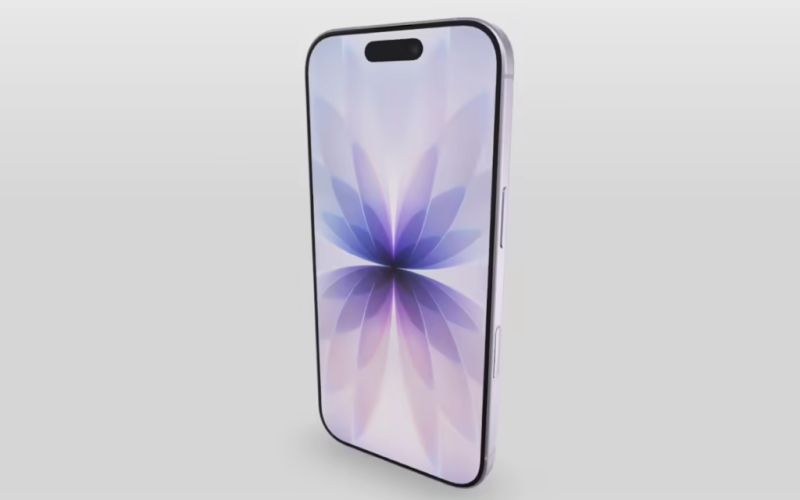
Bloomberg published a blog post yesterday (November 25), reporting that thanks to the strong sales momentum of the iPhone 17 series (excluding iPhone Air), Apple's iPhone shipments in 2025 are expected to reach 255 million units, a 10% year-over-year growth, which will surpass Samsung and claim the top spot in global smartphone sales.
Bloomberg cited multiple survey reports from the market research firm Counterpoint Research, revealing Apple's robust growth momentum. Data shows that in the first month after the iPhone 17 launch, Apple's sales in specific markets grew by 22%, while the overall phone market declined by 2.7% during the same period.
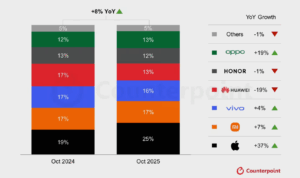
Another report indicates that Apple's iPhone sales in October increased by an impressive 37% year-over-year, outpacing the overall market's 8% growth, which demonstrates its strong market appeal.
IT Home cited the blog post, introducing that Counterpoint Research estimates Apple's full-year iPhone shipments in 2025 will reach 255 million units, compared to 231.8 million units in 2024, representing a 10% growth. This increase will elevate Apple's share in the global smartphone market to 19.4%, making it the leading manufacturer among all phone manufacturers. Meanwhile, Samsung's shipment growth for the same period is expected to be only 4.6%.
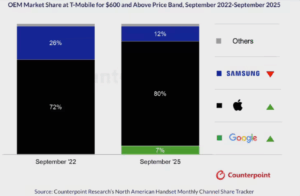
Apple's strong growth is not unfounded; its performance in the high-end markets of China and the United States provides a solid foundation for reaching the top. A previous Counterpoint report shows that as of September 2025, Apple's share in the U.S. T-Mobile carrier channel for high-end phones priced above $600 has increased from 72% in 2022 to 80%.
Additionally, in the Chinese market, Apple iPhone sales in October accounted for one-quarter of the total phone sales that month, with a 37% year-over-year growth, of which 80% came from the new iPhone 17 series.
Counterpoint analyst Yang Wang believes that, in addition to the iPhone 17 series receiving widespread acclaim, the turning point in the replacement cycle is also a key driving factor, as a large number of consumers who purchased phones during the COVID-19 pandemic are now entering the replacement phase.
Furthermore, from 2023 to the second quarter of 2025, a total of 358 million used iPhones were sold globally. Analysts point out that this vast user base is likely to upgrade to new iPhones in the coming years, providing Apple with sustained growth momentum.
Combining various data, Counterpoint Research believes that Apple is poised to seize the "crown" of the global smartphone market, while the long-time leader Samsung will fall back to second place.
Overview of Apple's Projected Dominance in the Smartphone Market
In a rapidly evolving global smartphone landscape, Apple Inc. appears set to reclaim its position as the world's leading smartphone manufacturer in 2025, driven primarily by the exceptional performance of its iPhone 17 series. This forecast, highlighted in a recent Bloomberg report citing Counterpoint Research, underscores a significant shift in market dynamics where Apple's shipments are anticipated to outpace those of Samsung Electronics Co., the longstanding market leader. The projections emerge amid broader industry trends, including lengthening replacement cycles, premiumization, and regional market recoveries, particularly in key areas such as China and the United States.
Key Projections and Growth Metrics
Counterpoint Research estimates that Apple's iPhone shipments will reach 255 million units in 2025, marking a 10% increase from the 231.8 million units shipped in 2024. This growth rate significantly outstrips Samsung's projected 4.6% increase, enabling Apple to capture a 19.4% share of the global smartphone market, positioning it ahead of all competitors. The overall global smartphone market is expected to grow by a more modest 3.3% in 2025, highlighting Apple's disproportionate gains.
To contextualise these figures, the following table summarises the projected 2025 smartphone shipment growth and market shares for major players, based on Counterpoint's analysis:
|
Manufacturer |
2024 Shipments (Million Units) |
2025 Projected Shipments (Million Units) |
YoY Growth (%) |
Projected Market Share (%) |
|
Apple |
231.8 |
255 |
10 |
19.4 |
|
Samsung |
Not Specified |
Not Specified |
4.6 |
Not Specified |
|
Overall Market |
Not Specified |
Not Specified |
3.3 |
100 |
These estimates exclude the rumoured iPhone Air model, focusing solely on the impact of the core iPhone 17 series.
Regional Performance and Market Drivers
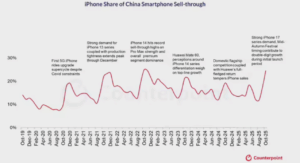
Strong regional performances bolster Apple's resurgence. In China, a critical market, iPhone sales surged 37% year-over-year in October 2025, capturing 25% of the total smartphone sales for that month. Remarkably, 80% of these sales were attributed to the new iPhone 17 series, indicating high consumer enthusiasm for the latest models. This performance far outpaced the overall market's 8% growth, showcasing Apple's ability to attract premium buyers even in a competitive environment dominated by local brands.
In the United States, Apple's dominance in the high-end segment is equally pronounced. As of September 2025, the company held an 80% share of the $600+ premium smartphone market through T-Mobile's carrier channels, up from 72% in 2022. This growth reflects Apple's entrenched position in premium pricing tiers, where features like advanced AI integration and ecosystem lock-in continue to drive loyalty.
Broader market data from Counterpoint reveals that in the first month following the iPhone 17 launch, Apple's sales in select markets rose by 22%, contrasting sharply with a 2.7% decline in the overall smartphone sector. Additionally, early sales data indicate that the iPhone 17 series is outselling the iPhone 16 series by 14% in the first 10 days in China and the US.
Underlying Factors Fueling Growth
Analysts attribute Apple's momentum to several interconnected factors. Counterpoint's Yang Wang emphasises the role of the replacement cycle inflexion point, where consumers who purchased devices during the COVID-19 pandemic (roughly 2020-2022) are now upgrading their devices. This wave of replacements is expected to sustain demand through 2025 and beyond.
Supporting this is the robust secondary market for iPhones. From 2023 to the second quarter of 2025, global sales of used iPhones totalled 358 million units. These devices often serve as entry points into the Apple ecosystem, with many users eventually upgrading to newer models, thereby providing a steady pipeline for future sales.
The iPhone 17 series itself has received widespread acclaim for its innovations, contributing to initial sales outperformance. Global smartphone revenues also grew 5% year-over-year in Q3 2025, reaching $112 billion, driven by premiumization trends that favour Apple's positioning.
Long-Term Outlook and Industry Implications
Counterpoint forecasts that Apple will maintain its top position through at least 2029, potentially reshaping competitive dynamics. However, challenges remain, including geopolitical factors like US tariffs, which led Counterpoint to revise its overall 2025 global smartphone shipment growth forecast downward to 1.9% earlier in the year (though later projections align with 3.3% market expansion).
For Samsung, the projected slower growth could prompt strategic shifts, such as enhanced focus on foldables or emerging markets. Meanwhile, Apple's trajectory suggests continued emphasis on premium features and ecosystem expansion to retain its lead.
This analysis draws from multiple Counterpoint reports, including quarterly shipment trackers and product-specific forecasts, which collectively paint a picture of Apple's strategic advantages in a maturing market. As the industry navigates uncertainties, these projections highlight the enduring appeal of Apple's brand and innovation pipeline.
The above content is compiled by ModeZone, a fashion and entertainment magazine.