

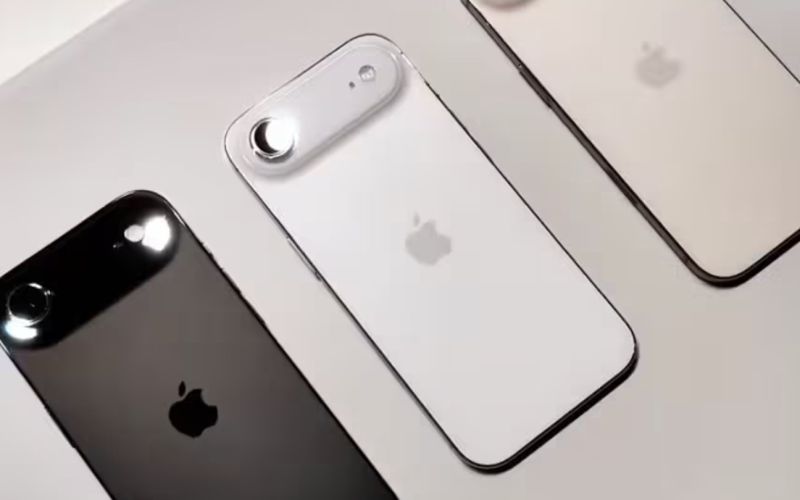
November 3 News — In September, Apple launched the “thinnest iPhone ever,” the iPhone Air, which is only 5.6mm thick, features a 6.5-inch 120Hz display, a 48MP single rear camera, and the A19 Pro processor, starting at 7,999 RMB in China. However, the device didn’t officially go on sale until October 22.
Why aren’t people buying the iPhone Air?
Different user groups and usage scenarios drive manufacturers to create increasingly diverse products.
The iPhone Air, much like the 12-inch MacBook, isn’t designed as an entry-level product. Instead, it reflects Apple’s Jony Ive-era philosophy — appealing to those willing to pay extra and accept trade-offs in pursuit of extreme design and distinctiveness.
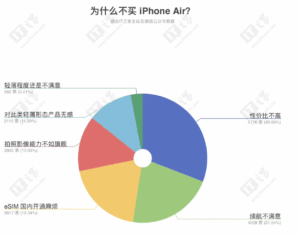
Following the question “Why not buy the iPhone Air?”, a local media outlet launched a poll in early November. As of 3:30 PM on November 3, after 48 hours, the total votes across the website and WeChat platform had exceeded 10,000, with thousands of comments offering diverse opinions.
On November 1, the iPhone Air received its first government subsidy, lowering its starting price to 7,599 RMB. Still, the top comment under the related post bluntly stated: “Even if it were 3,000 cheaper, it might still struggle to sell.”
The poll results support this sentiment — the most-voted reason was “Not cost-effective”, receiving 3,937 votes (63.15%) on the website and 1,835 votes (30.69%) on WeChat, totaling 5,772 votes.
Battery life concerns
As smartphone use becomes more intensive, users have developed clearer expectations for their devices, particularly regarding battery performance. The main reason most people considered buying the iPhone Air was its lightweight design, but to achieve thinness, Apple made significant compromises.
Its 3,149mAh battery is notably smaller than that of the iPhone 17 Standard Edition (3,692mAh).
Although Apple introduced an AI Adaptive Battery feature in iOS 26, many users remain concerned about battery life. “Unsatisfactory battery life” ranked second in the poll, with 2,739 votes (43.94%) on the website and 1,286 votes (21.51%) on WeChat — 4,025 votes in total.
This reflects a pragmatic trend: users are prioritizing endurance for daily use, and the iPhone Air’s power limitations make it hard to meet the general needs of diverse user scenarios.
eSIM barriers in China
Another key issue is China’s eSIM limitations — the iPhone Air supports only dual eSIMs, and some carriers require users to handle registration at their number’s original location.
Many consumers expressed frustration, commenting that “it’s way too hard to get an eSIM activated.”
This factor ranked third in the poll, with 2,389 votes (38.32%) on the website and 1,227 votes (20.51%) on WeChat.
However, as China’s eSIM ecosystem continues to mature and user adoption grows, the situation is expected to improve.
Changing consumer logic
In today’s smartphone market, consumers’ decisions about ultra-thin models like the iPhone Air are clearly not driven by thinness alone. Instead, they focus on overall performance balance — battery life, practicality, and value for money — all essential for daily use.
The current poll results underscore this mindset.
Sales performance and reactions
During Apple’s Q4 FY2025 earnings call, CEO Tim Cook declined to directly address analysts’ questions about iPhone Air sales.
Tech blogger @数码闲聊站 revealed that the first-week activation volume for the iPhone Air was just over 50,000 units, calling the results “quite disappointing.”
Nevertheless, active communities of early adopters have emerged online. These users — eager to share their experiences — have significantly influenced broader consumer perceptions of emotional value, functional expectations, and design aesthetics through video reviews, community discussions, and live streams.
The above content is compiled by ModeZone, a fashion and entertainment magazine.