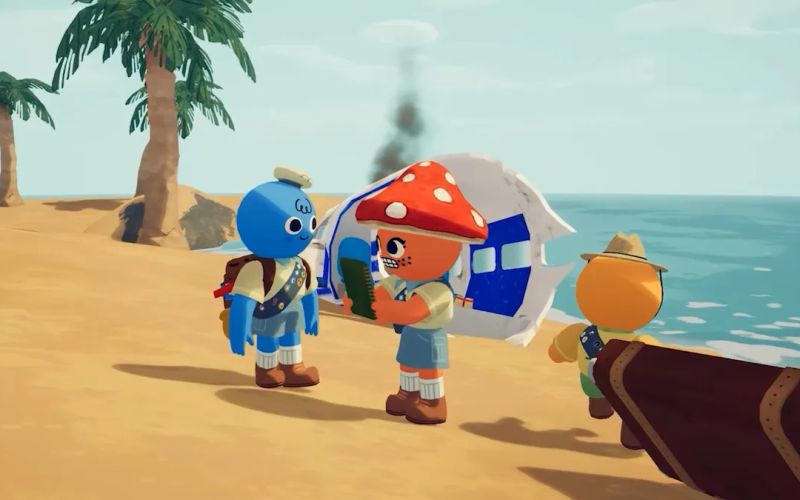
What does it actually mean for a Game Jam project to sell 10 million copies? The developers of Peak probably haven't fully wrapped their heads around it either.
Born from a four-week limited-time collaboration between indie studios Aggro Crab and Landfall, this game was originally just a "for fun" project. Who knew it would blow up immediately upon release? Players flooded in so fast the servers couldn't handle the load, and sales skyrocketed, now smashing past the 10-million mark.
Success came suddenly, but so did the inevitable question: Will this game keep updating forever like those long-running live-service MMOs?
Aggro Crab lead Nick Kaman gave a pretty direct answer: No.
"We don't plan to make this a 'forever game'"
Kaman was clear: Peak was never intended to go down the live-service route. Stuffing content into it indefinitely or updating just for the sake of updating—that's not what they want to do.
"We could certainly milk this game for a long time," he said. "But our goal is to finish everything we actually want to do, and then move on to the next project."
In other words, Peak will have an end date. But until then, not a single piece of planned content will be left behind.
What’s the team’s status? Honestly, they're near their limit.
Currently, the entire dev team is supporting Peak full-time, while the studio's other title, Crashout Crew, is also in progress. Kaman described the team as running on "pure adrenaline"—the update intensity over the past few months has been massive, and everyone is bordering on burnout.
What to expect next:
-
Slower Cadence: The update pace will definitely slow down. 2026 won't see releases as dense as 2025.
-
Quality over Quantity: Every update will be substantial, rather than just small patches or minor fixes.
-
Current State: The most recent update was the winter holiday event (adding temporary fun like snowball fights). Future core content is in planning, though a specific timeline hasn't been set.
A Rare Attitude in the Industry
This perspective is actually quite refreshing.
In the current online gaming market, success usually leads to infinite expansion: season after season, battle pass after battle pass, with monetization buried deeper and deeper. Many games end up bloated, leaving both players and developers exhausted.
Peak’s approach is a breath of fresh air. It doesn't pursue infinite inflation or iterate madly just to maintain retention metrics. They want to finish what they started, then stop.
Kaman’s philosophy is simple: "This won't be a forever game, but we also don't want to abandon any content that should be there."
It sounds like common sense, but in this industry, there are very few teams who can say that and actually mean it.
The Verdict?
Peak will continue to receive updates, but don't expect it to turn into the next Destiny 2 or Fortnite. The developers know exactly when to wrap up and when to move on to new things.
For players, this might actually be a good thing—at least you don't have to worry about the game suddenly becoming unrecognizable one day.
The above content is compiled by ModeZone, a fashion and entertainment magazine.