

OpenAI Releases “Teen Safety Blueprint” to Better Protect Young Users from Harm
OpenAI has introduced a new framework designed to safeguard younger users following high-profile incidents in which its flagship conversational AI, ChatGPT, was criticised for failing to appropriately help users in psychological distress.
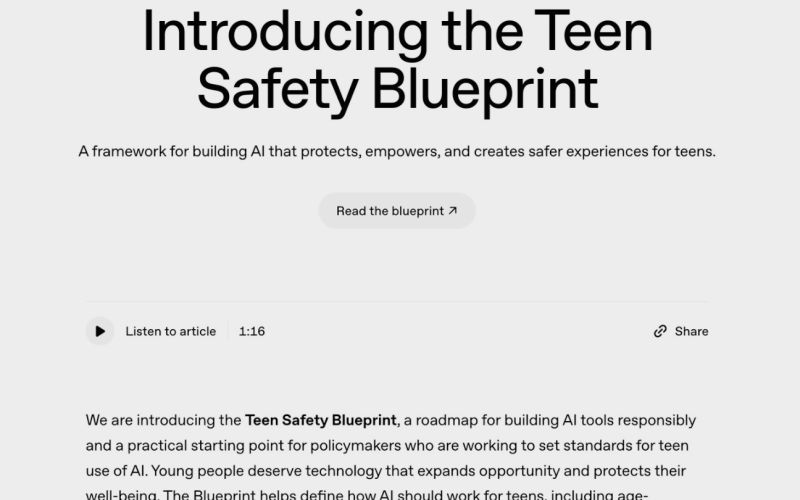
The “Teen Safety Blueprint” outlines a set of protections crafted specifically for adolescent users. According to OpenAI, the system will treat minors differently from adult users — requiring automatic age estimation, age-appropriate responses, parental controls, and special emergency-intervention mechanisms for users showing signs of emotional distress.
Under the framework, ChatGPT will deploy default settings that are more restrictive when the user is suspected of being under 18 years of age. The chatbot will be prohibited from providing content such as self-harm instructions, dangerous internet challenge advice, or body-image coaching. It will also block intimate role-play with minors and disallow facilitating contact between adults and minors. OpenAI is currently developing an age-prediction system to decide whether a user is under 18, and will assign the “teen experience” when uncertainty remains.
OpenAI acknowledged that these measures were introduced to correct previously identified safety gaps. For example, the company referenced the case of a teenager in the U.S. whose interactions with ChatGPT reportedly did not trigger an adequate crisis response — an incident now subject to litigation. OpenAI stated that it had updated its model in October to improve its ability to identify crises and filter the relevant content.
In its blog post titled “Teen Safety, Freedom and Privacy”, OpenAI emphasised that while adult users are treated as “adults”, younger users are subject to stricter protections:
“We prioritise safety ahead of privacy and freedom for teens … First, we must distinguish users under 18 from those who are not.” — Sam Altman, OpenAI CEO.
The new policies also introduce features such as parental account-linking, notification of acute distress, and potential escalation to authorities when young users show signs of self-harm or suicidal ideation.
The above content is compiled by ModeZone, a fashion and entertainment magazine.