


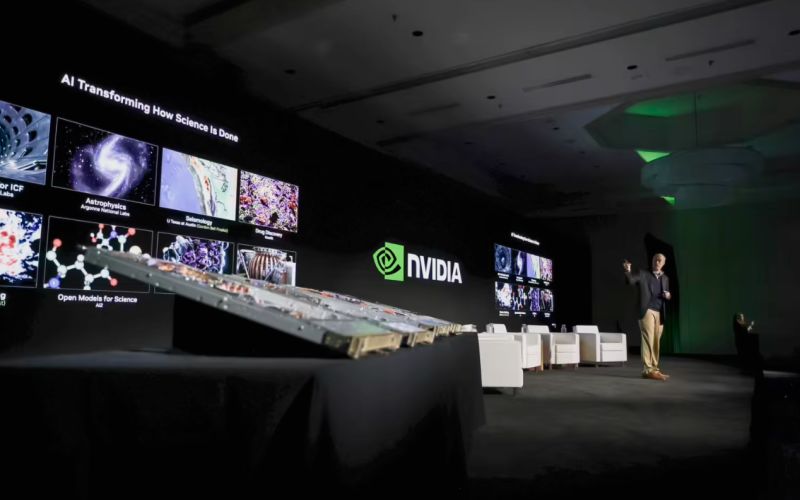
At the SC25 conference, NVIDIA announced a series of updates related to AI supercomputing, including the Apollo family of open AI physics models and the Warp physics-simulation open-source Python framework.
Focusing on physics-based AI, NVIDIA unveils the Apollo model series and Warp framework at SC25.
The Apollo model series is designed for fields such as electronic design automation and semiconductor design, structural mechanics, weather and climate modeling, computational fluid dynamics, electromagnetics, and multiphysics applications. Apollo combines state-of-the-art machine learning architectures, such as neural operators, Transformer models, and diffusion methods, with domain-specific knowledge.
Companies including Applied Materials, Cadence, Lam Research, Luminary Cloud, KLA, PhysicsX, Rescale, Siemens, and Synopsys are adopting these open models to simulate and accelerate their design workflows.
Focusing on physics-based AI, NVIDIA unveils the Apollo model series and Warp framework at SC25.
The Warp framework provides a structured approach for simulation, robotics, and machine-learning workloads. It pairs the ease of use of Python with performance comparable to native CUDA code, delivering up to 245× GPU acceleration for computational physics and AI tasks.
The framework supports building GPU-accelerated 3D simulation workflows and can be integrated into ML pipelines in PyTorch, JAX, NVIDIA PhysicsNeMo, and NVIDIA Omniverse.
Companies such as Siemens, Neural Concept, and Luminary Cloud are adopting NVIDIA’s Warp technology.
The above content is compiled by ModeZone, a fashion and entertainment magazine.