

What: DeepSeek V3.2 Is Live (Plus “Speciale” Edition)
- DeepSeek today officially released DeepSeek V3.2 and a more powerful variant, DeepSeek V3.2-Special.
- The standard V3.2 is now available via DeepSeek’s web interface, mobile app, and API.
- The “Speciale” version, by contrast, is currently only available via a temporary API endpoint for community testing and research.
🧠 What’s New: Better Reasoning, Agent Abilities & Efficiency
DeepSeek V3.2
- V3.2 is described as balancing reasoning strength with manageable output length, making it suitable for everyday use, such as Q&A and general-purpose agent tasks.
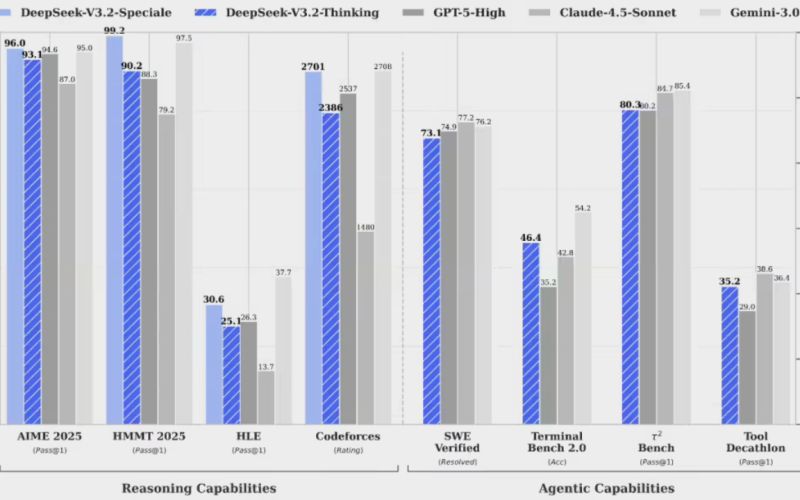
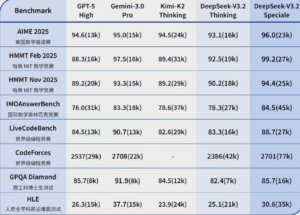
- In public reasoning-type benchmarks, V3.2 reportedly reaches “GPT-5 level,” narrowly behind Gemini 3.0 Pro.
- The model employs a novel architecture (“sparse attention”, mixture-of-experts, efficient inference) to reduce computational cost and accelerate long-context inference — achieving claimed cost reductions of ~50–70%.
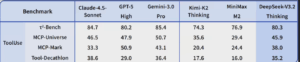
- DeepSeek states that V3.2 supports tool use with integrated reasoning, meaning it can call external APIs (such as code execution and search) while “thinking,” thus enabling more capable agents.
DeepSeek V3.2-Speciale
- “Speciale” is described as the “long-thinking” enhanced version of V3.2, combining reasoning, mathematics, and logical verification abilities (leveraging what DeepSeek previously developed in its Math/Prover-type variants).
- According to some reports, this version pushes the boundaries of open-source model reasoning, particularly in complex tasks and scientific or mathematical reasoning.
- Due to its larger computational needs (resulting from “long thinking” and heavier reasoning), Speciale is currently positioned more for research/benchmark use, rather than being optimized for everyday chat / content-generation tasks.
📊 Why It Matters: Narrowing the Gap Between Open & Closed Models
- DeepSeek V3.2 reportedly shrinks the performance gap between open-source and closed-source “top-tier” models, especially on reasoning benchmarks.
- With its sparse-attention and mixture-of-experts architecture, V3.2 offers significantly lower computational cost for similar reasoning performance, making high-end AI more accessible.
- The integration of “thinking + tool use” suggests a shift toward more capable agent-style AI, including long-term memory, context retention across tasks, the ability to call APIs, and the execution of code/data tasks — features necessary for advanced autonomous agents.
⚠️ What We Should Treat as “Claims / Early.”
- If V3.2 reaches a “GPT-5 level,” there is no independent, third-party audit. The “Special” version’s claimed performance (especially in math/logic/reasoning) is interesting. Still, since it’s currently research-only, it may not be as polished or robust for general use (e.g., content generation, conversational quality, safety).
• • Performance on public benchmarks doesn’t always translate into safe and reliable performance in real-world, open-ended tasks — generalization, robustness, hallucination resistance, and misuse potential, among others, remain to be tested over time.
The above content is compiled by ModeZone, a fashion and entertainment magazine.